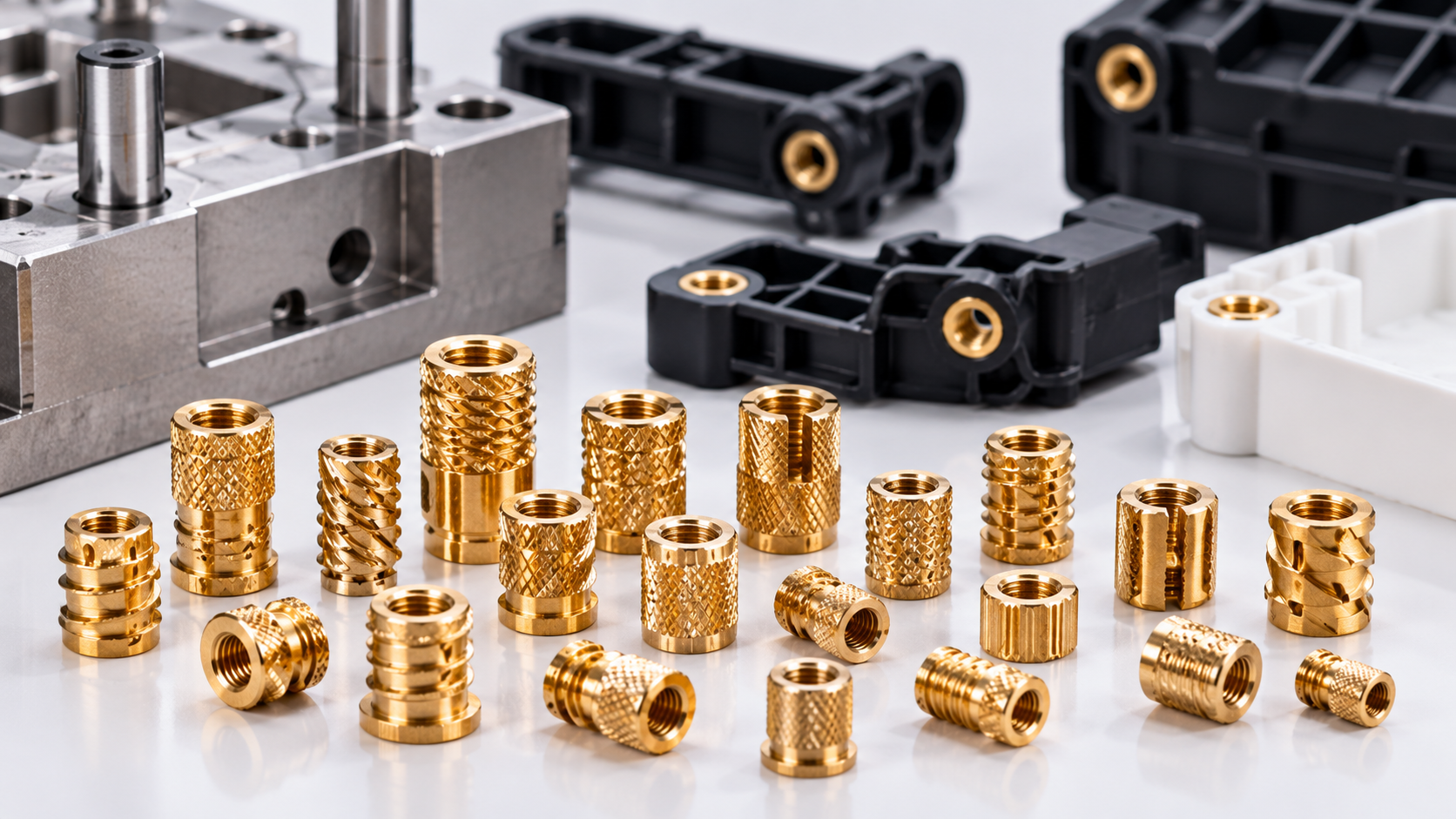
Brass Inserts for Plastic Moulding: Types, Knurling & Applications
Plastic products have become quite popular as they are lightweight, cost-effective, and used in various items. However, using screws in plastic elements might cause some trouble, such as loosening connections, wearing threads, and damaging parts after numerous repairs. Such things may become really annoying when it comes to the necessity of repairing your product.
This is when brass inserts for plastic come in handy, as they allow building stronger threads and use them as many times as needed. Besides, these inserts facilitate the production process as well as the assembly of products.
Learning about the types of brass inserts for plastic, their surface patterns, and applications will let you select the right insert for your needs.
Small Components That Make Plastic Connections Stronger
Brass inserts are metal components with threads inserted into plastic parts. They ensure the presence of strong internal threads for screws and bolts. Brass inserts provide more durability than threads made in plastic. In addition, brass has high resistance to corrosion and can be produced in any desired size. The length, diameter, and type of thread will depend on the particular demands of the manufacturer.
Different Inserts for Different Installation Needs
Not all brass inserts for plastic are installed the same way.
- Heat-set inserts are set in plastic using controlled heat, which softens the thermoplastic around the element.
- Ultrasonic inserts are set with the help of vibration that produces heat.
- Moulded-in inserts are put into the mould before plastic injection.
- Self-tapping inserts are installed by gripping the hole with the element's outer threads.
- Mechanical pressure is used for the installation of press-fit inserts.
So, the choice will depend on the plastic material, required strength, and installation equipment.
Why the Outside Pattern Matters?
The pattern on the outside of the brass insert is called knurling. It increases the stability of the plastic around the insert and prevents it from sliding off. There are several patterns, such as a straight one with lengthwise grooves, a diamond pattern with crossing grooves, a helical pattern with angled grooves, and a ring pattern resistant to pulling forces.
However, the wrong pattern can reduce the connection strength and damage the plastic. This means that manufacturers should pay attention to wall thickness, material hardness, and installation method.
Where Are Brass Inserts Commonly Used?
Brass inserts for plastic are often used in electrical devices, automotive parts, household appliances, and industrial equipment. For instance, they are applied in such places as enclosures, dashboards, control panels, machine covers, and other places that require frequent opening and repair. When ordering brass inserts for plastic parts, make sure to specify thread size, hole diameter, maximum load, and required torque. This will help to avoid improper fitting and premature breakage.
Conclusion
Using the right brass inserts for plastic will make the connections stronger and will enable easy repair of the products. If you are searching for inserts suitable for your products, contact Ishita Industries to discuss your requirements for manufacturing.

