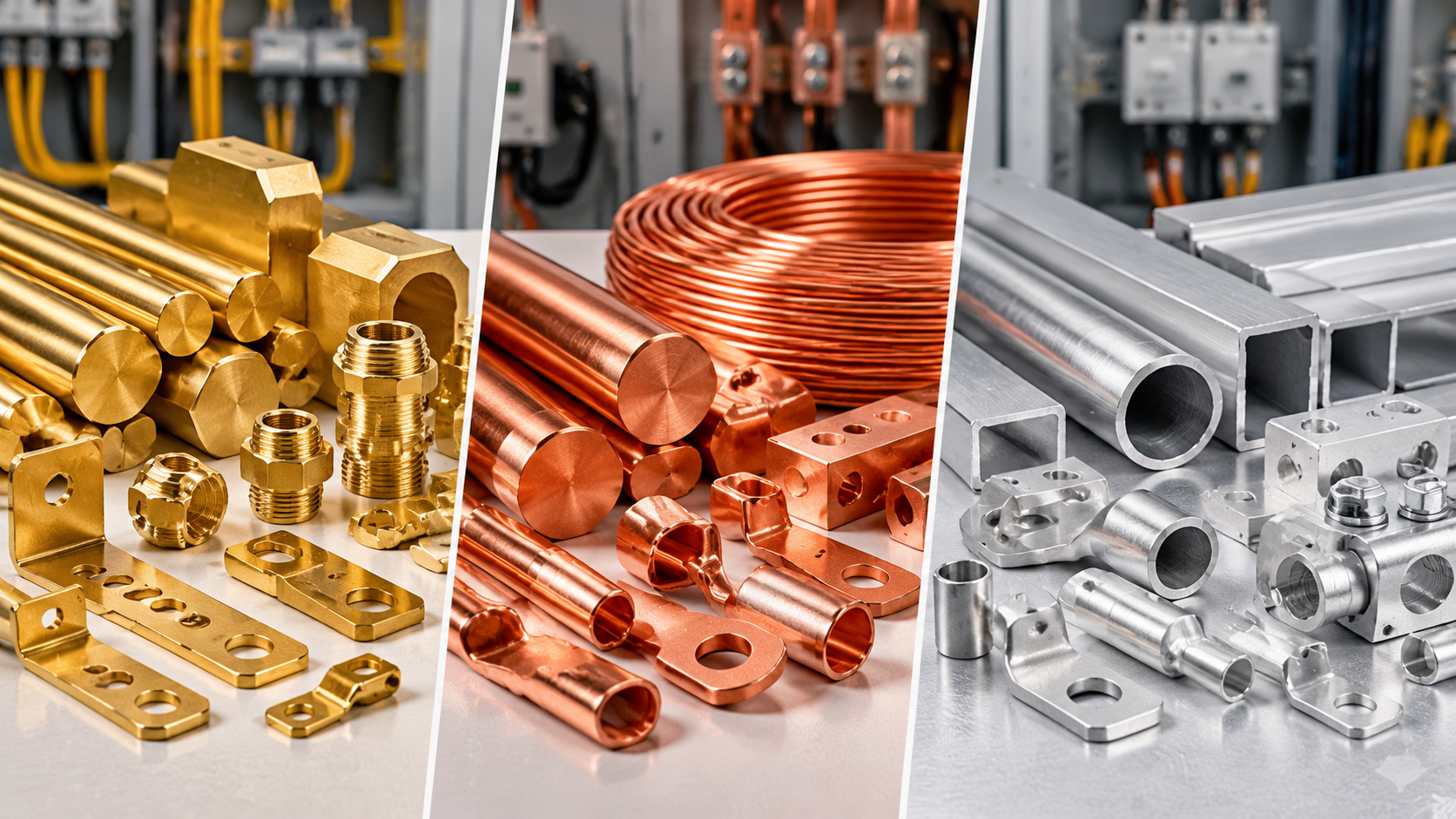
Brass vs Copper vs Aluminium: Which Material Is Best for Electrical Components?
Choosing a metal for an electrical component can get complicated faster than expected. Copper may seem like the obvious choice because conductivity matters. But what if the part also needs precise threads, extra strength, lower weight, or repeated assembly? That is where the decision gets tricky.
A material perfect for the busbar will not work well for the threaded connector or light component. Thus, it makes sense to consider what your component really needs rather than selecting the best metal in general.
Use Copper for Efficient Current Flow
Copper is usually selected when efficient electrical conductivity is needed. It enables efficient current flow, making it ideal for conductors, terminals, lugs, busbars, rods, profiles, etc.
But conductivity is not the only criterion to use when choosing the metal. There are cases when copper is not the best material to select due to other requirements of the component.
Choose Brass for Precise Machining and Accurate Threads
Brass can be considered a compromise between conductivity, strength, machinability and dimensional stability. As such, it may fit well in the case when precise shapes and reliable connections are required.
Thus, brass is used for electrical pins, terminals, connectors, neutral links, contacts, meter parts, switchgear components and many other types of components requiring precise shapes, threads or connections. Brass may be turned, milled, forged, stamped, broached, threaded and knurled to obtain such profiles.
Additionally, its properties allow achieving repeated dimensions of the component during prototype and OEM production runs.
Select Aluminium to Reduce the Weight of the Component
Reduced weight of the component makes aluminium very attractive. Reduced weight makes it easier to handle, install, transport and design the whole system.
Additionally, it can be used for profiles and sections, where reduced weight is more important than increased density of brass or copper. Aluminium may be extruded to provide a consistent profile before machining.
But you should take into account the electrical duty, mechanical load, design of connections, operating environment and geometrical form before using aluminium. Complex threads and repeated mating connections are more suitable for brass.
Brass vs Copper vs Aluminium: Select the Metal According to the Requirements of the Component
So, you still cannot decide? The easiest way to compare these metals is to think about their capabilities and the jobs that the components require.
| Priority | Material Often Considered |
| High conductivity and efficient current transfer | Copper |
| Precision machining and accurate threads | Brass |
| Strength and dependable assembly | Brass |
| Lightweight construction and easier handling | Aluminium |
| Extrusion-based profiles | Aluminium |
Thus, there is no winner. A component used for current transfer may require copper, while a threaded connector may suit brass better. And a light profile is better for aluminium. The choice depends on the component's function, shape, operation, and manufacturing process.
Why the Choice of the Manufacturing Process is Important
Choosing the correct metal is half of the job. Incorrect machining or inappropriate finishing may affect the component even if the material is appropriate.
The processes may include casting, extrusion, turning, forging, stamping, broaching, milling, knurling and threading. Depending on the specification, proper finishing and inspection are also important.
Choose the Right Metal for Your Electrical Component
Copper offers high conductivity, brass combines precision, strength, and machinability, and aluminium is lightweight.
Need components produced according to the technical requirements?
Contact Ishita Industries to find out the suitable material and manufacturing process for your electrical component requirements.

